
What the NCIS File Says
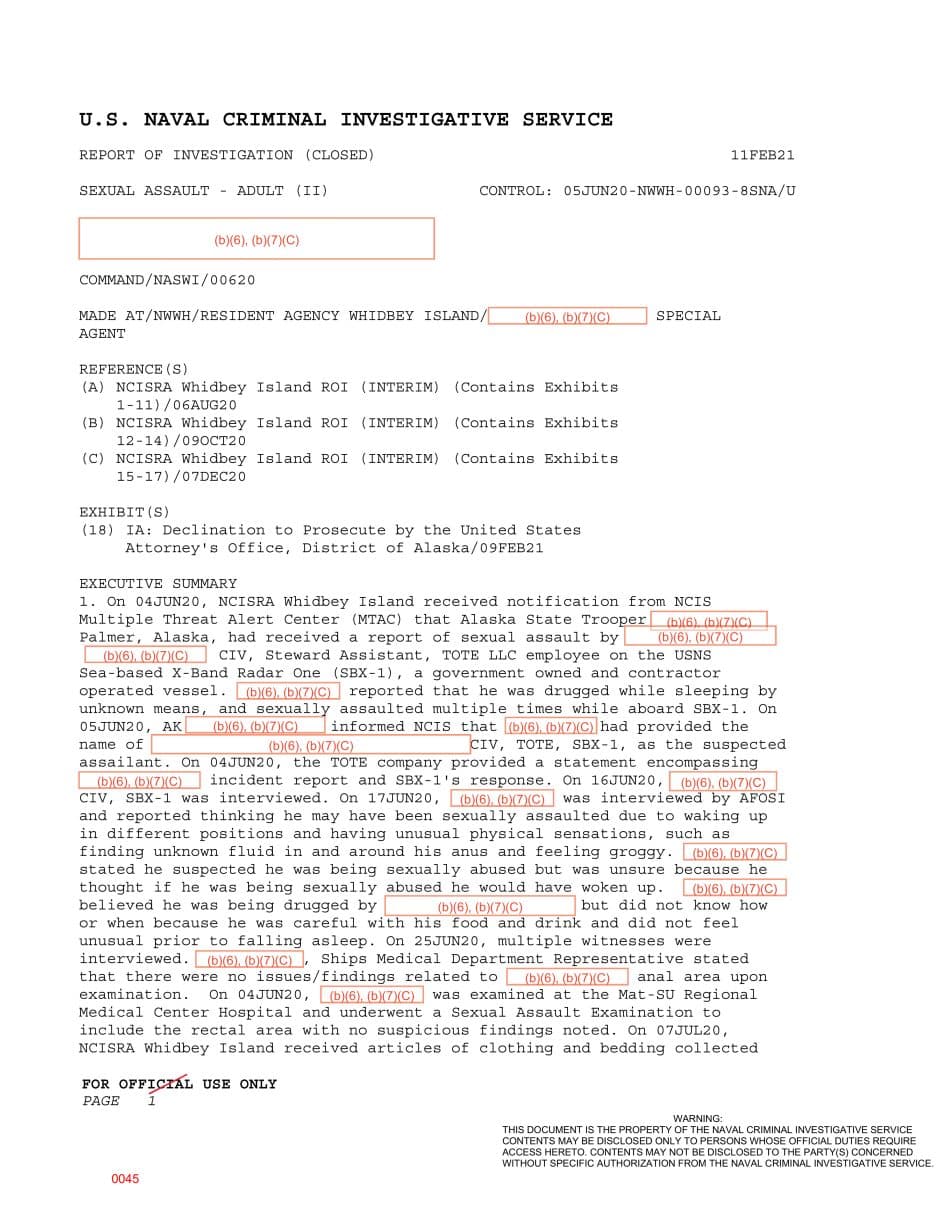
The case began on June 4, 2020, when NCIS Resident Agency Whidbey Island received word through the NCIS Multiple Threat Alert Center that an Alaska State Trooper in Palmer, Alaska, had received a sexual assault report from a TOTE LLC steward assistant assigned to SBX-1.
The source file describes SBX-1 as a government-owned, contractor-operated vessel. That setting put the report inside a mixed accountability system: a TOTE employee and SBX-1 worker, an Alaska state police contact, NCIS, Air Force investigators, Navy legal offices, Military Sealift Command Pacific area counsel, and federal prosecutors all appear in the handling of the allegation.
The reporting person said he believed he had been drugged while sleeping by unknown means and sexually assaulted multiple times aboard SBX-1. The next day, Alaska authorities told NCIS that he had provided the name of another TOTE / SBX-1 person as the suspected assailant.
TOTE provided a statement on June 4 that the NCIS summary says encompassed the incident report and SBX-1's response. SBX-1 personnel were interviewed on June 16, and the Air Force Office of Special Investigations interviewed the reporting person on June 17.
In the AFOSI interview as summarized by NCIS, the reporting person said he thought he may have been sexually assaulted because he woke up in different positions, felt groggy, and noticed unusual physical sensations, including unknown fluid in and around his anus. He also told investigators he was unsure because he thought he would have awakened if he were being sexually abused.
The reporting person said he believed he was being drugged, but the file says he did not know how or when because he was careful with his food and drink and did not feel unusual before falling asleep. The NCIS executive summary says ship medical personnel reported no issues or findings related to his anal area during examination, and that a Mat-Su Regional Medical Center sexual-assault examination, including the rectal area, noted no suspicious findings.
Investigators gathered and reviewed several categories of evidence. NCIS received clothing and bedding collected from the reporting person, later received witness statements, cellular phone information, and a DNA sample from AFOSI, ran database checks, reviewed medical and toxicology records, and reviewed SBX-1 VingCard door-lock data.
The toxicology review found no drugs, according to the NCIS executive summary. The file also says an Assistant United States Attorney in Alaska was consulted about lack of probable cause that a crime occurred.
NCIS interviewed the named suspected assailant in November 2020, and the person denied all allegations. NCIS later received the Alaska State Trooper's report and, on February 5, 2021, received a declination letter from the United States Attorney's Office declining prosecution due to insufficient evidence.
The displayed source is a short closed report. It references three earlier interim reports and exhibits that are not included in the readable transcript, so the public record here preserves the closure summary, source PDF, and OCR text while noting that some underlying investigative materials are absent from this extracted file.
Case Timeline
An Alaska State Trooper received the sexual assault report, NCIS was notified through the Multiple Threat Alert Center, and TOTE provided a statement covering the incident report and SBX-1's response.
Alaska authorities informed NCIS that the reporting person had named another TOTE / SBX-1 person as the suspected assailant.
SBX-1 personnel were interviewed, according to the NCIS executive summary.
AFOSI interviewed the reporting person about waking in different positions, feeling groggy, and believing he may have been drugged and sexually assaulted.
Multiple witnesses were interviewed, and ship medical personnel reported no issues or findings related to the reporting person's anal area.
NCIS received clothing and bedding collected from the reporting person.
NCIS received witness statements, cellular phone information, and a DNA sample from AFOSI.
Medical and toxicology records were reviewed, and no drugs were identified.
Investigators reviewed SBX-1 VingCard door-lock readout data.
An Assistant United States Attorney in Alaska was consulted about lack of probable cause that a crime occurred.
The named suspected assailant was interviewed and denied the allegations.
NCIS received a copy of the Alaska State Trooper's report.
NCIS received a declination letter from the United States Attorney's Office declining prosecution due to insufficient evidence.
Why This Record Matters
- The file highlights the difficulty of investigating a sleep-based sexual assault allegation aboard a contractor-operated maritime platform when the reporting person believed he may have been drugged but did not know how or when.
- The record shows a layered response involving TOTE, SBX-1 personnel, Alaska State Troopers, AFOSI, ship medical personnel, NCIS, Navy legal offices, Military Sealift Command Pacific area counsel, and federal prosecutors.
- The investigative path turned on physical examinations, toxicology, clothing and bedding, phone information, DNA, witness statements, database checks, and SBX-1 door-lock data, but the U.S. Attorney's Office still declined prosecution for insufficient evidence.
- The extracted closure report references three earlier interim reports and exhibits that are not included in the readable transcript, limiting what readers can verify from this public excerpt.